- List your property - it's free
- Sign up or Log in
- English- en
- THB - ฿
- Buy
- Thailand Property For Sale
- Thailand Real Estate
- See Newest Listings
- Why Buy with FazWaz
- Rent
- Sell
- Financing
- Projects
- Advice
- Join Us We're Hiring!
Thailand has long been a dream destination for people looking to invest in property. Whether it’s a beachfront condo in Phuket, a modern apartment in Bangkok, or a peaceful villa in Chiang Mai, the Thai real estate market offers plenty of opportunities. But the question of how to pay for property is one of the most important decisions a buyer has to make.
In Thailand, there are three main paths to property ownership: paying cash upfront, taking a mortgage through a bank, or entering into a Rent-to-Own (RTO) agreement. Each of these methods comes with very different implications in terms of cost, eligibility, speed, and long-term flexibility. Cash is simple and fast, mortgages allow you to spread payments but are often hard for foreigners to secure, and Rent-to-Own is an emerging alternative that combines elements of both renting and buying.
This article explores each method in detail, compares their advantages and drawbacks, and highlights who they are best suited for.
For many buyers, especially retirees and investors, paying cash is the most straightforward option. In this scenario, the entire purchase price, along with applicable taxes and transfer fees, is settled upfront. Once the money is transferred and the deal registered at the Land Department, ownership changes hands immediately.
The appeal of paying cash lies in its simplicity. There are no banks involved, no loan approvals, and no complex financial documentation. Deals can often be completed within days, making it the fastest way to secure property. Sellers also tend to favor cash buyers because there is little risk of financing falling through, and this often gives buyers stronger negotiation power. A seller may be more willing to offer a discount, throw in additional benefits like furniture packages, or cover transfer costs if the buyer can settle immediately.
Another important benefit of paying cash is peace of mind. The buyer owns the property outright, with no monthly obligations or interest charges. For retirees who want to live debt-free, or for investors looking to rent or resell quickly, this is highly attractive.
The drawback, of course, is liquidity. A cash purchase requires significant capital, which ties up funds that could otherwise be invested elsewhere. For example, buying a condominium for 5 million baht not only means spending the full amount at once but also adding another 3–6 percent in transaction costs. While this brings security, it reduces financial flexibility. Buyers also lose the chance to leverage debt to increase investment returns, which is common in other property markets.
Cash purchases therefore tend to suit those who have substantial savings or liquid funds and prefer security and simplicity over financial leveraging.
For those without the ability or willingness to pay the full amount upfront, mortgages provide a way to spread the cost of property ownership. In Thailand, however, the mortgage system is more restrictive than in many other countries, especially for foreigners.
Thai nationals can usually secure loans covering 80 to 90 percent of a property’s value, but for foreign buyers the figure is usually capped at 50 to 70 percent. The remaining balance has to be covered as a down payment, which is already a significant amount. On top of that, foreigners must meet strict eligibility requirements. Banks generally prefer long-term residents with valid work permits, business visas, or permanent residency. A tourist visa will not suffice. Applicants must show stable, provable income either in Thailand or abroad, with salaried employees having an advantage over freelancers or business owners whose documentation is harder to standardize.
The loan terms themselves vary. Some Thai banks allow foreign currency loans, for example in US dollars or Singapore dollars, particularly for applicants with overseas income. These can be useful for expatriates but also carry currency exchange risks. In terms of duration, repayment periods for foreigners are usually shorter, and loan-to-value ratios are lower than those for locals.
There are, however, some institutions that stand out. United Overseas Bank (UOB) provides international property loans in Thailand with relatively generous conditions, such as up to 70 percent loan-to-value and repayment periods of up to 35 years, though the requirements are steep: the property must be in Bangkok or approved areas, the loan is issued in foreign currency, and expats working in Thailand must earn at least 140,000 baht per month with two years of work history under a valid permit.
Another avenue is through marriage to a Thai spouse. Some Thai banks will extend loans if the property is registered under the spouse’s name, with the foreigner acting as guarantor. This opens the door to more favorable loan terms but raises legal considerations since the foreign buyer cannot directly own the property under their own name.
Finally, MBK Guarantee offers what many consider the most foreigner-friendly option. Unlike Thai banks, MBK does not restrict applications based on nationality, marital status, or work permits. However, the loans are smaller, typically capped at one million baht, and limited to around 50 percent of the property’s appraised value. Repayment terms are shorter as well, usually up to ten years. This makes MBK suitable for modest condominium purchases but less so for luxury properties.
The main advantage of mortgages is that they allow buyers to preserve liquidity and spread out costs. However, the disadvantages — high down payments, strict documentation, complex applications, and rejection risks — make them difficult for many foreigners. Those who do qualify tend to be long-term expatriates with stable, documented salaries or foreigners married to Thais.
Rent-to-Own (RTO) is an emerging model in Thailand that offers an alternative to both cash purchases and mortgages. It is designed to help buyers who have the financial ability to pay monthly but are blocked by the strict requirements of banks.
The concept is simple: the buyer pays an initial down payment, usually around 20 to 30 percent of the property’s price, and then continues to pay monthly installments that are structured like rent but contribute toward ownership. At the end of the agreed period, which often ranges between one and five years, the buyer completes the remaining payments and the title deed transfers into their name.
What makes RTO especially attractive is accessibility. Unlike bank mortgages, RTO is open to foreigners without work permits, self-employed individuals, digital nomads, or those with irregular income streams. As long as they can commit to the monthly payments, they can participate. This opens the door to ownership for a much wider range of buyers who would otherwise be excluded.
Another strong advantage is certainty. The purchase price is agreed upon from the start, allowing the buyer to lock in today’s value even if the market rises. This is especially important in popular locations like Bangkok or Phuket, where property prices may appreciate significantly over a few years.
Rent-to-Own also allows buyers to start living in their home immediately, unlike mortgages where approval delays can hold up the move-in process. Each monthly payment contributes toward eventual ownership, so instead of paying rent to a landlord without return, buyers are effectively building equity.
Of course, RTO has limitations. The monthly payments are typically higher than standard rent because part of the payment goes toward ownership. Buyers also need to commit; if they fail to complete the agreement, they risk losing deposits or option fees. Additionally, terms are shorter compared to mortgages, so buyers must be prepared to complete the purchase within a few years rather than over decades.
Still, the appeal of RTO is growing. FazWaz has pioneered Rent-to-Own in Thailand, creating standardized contracts, escrow protections, and a structured process that protects both buyers and sellers. This has brought professional oversight to a model that was previously informal, making it a credible and secure option.
When comparing cash, mortgages, and Rent-to-Own, the differences become clear. Cash is the fastest and simplest route, offering immediate ownership and security but demanding large liquidity. Mortgages allow payments to be spread over time but come with high barriers for foreigners, including steep down payments and strict eligibility requirements. Rent-to-Own sits in the middle, requiring less upfront capital than cash and fewer hurdles than bank loans, while still allowing buyers to gradually achieve ownership.
A retiree with savings may prefer cash for its simplicity and peace of mind. An expat with a work permit and stable income might benefit from a mortgage, especially if they qualify for favorable terms. A digital nomad, self-employed professional, or foreigner without access to bank financing may find Rent-to-Own the most realistic path forward.
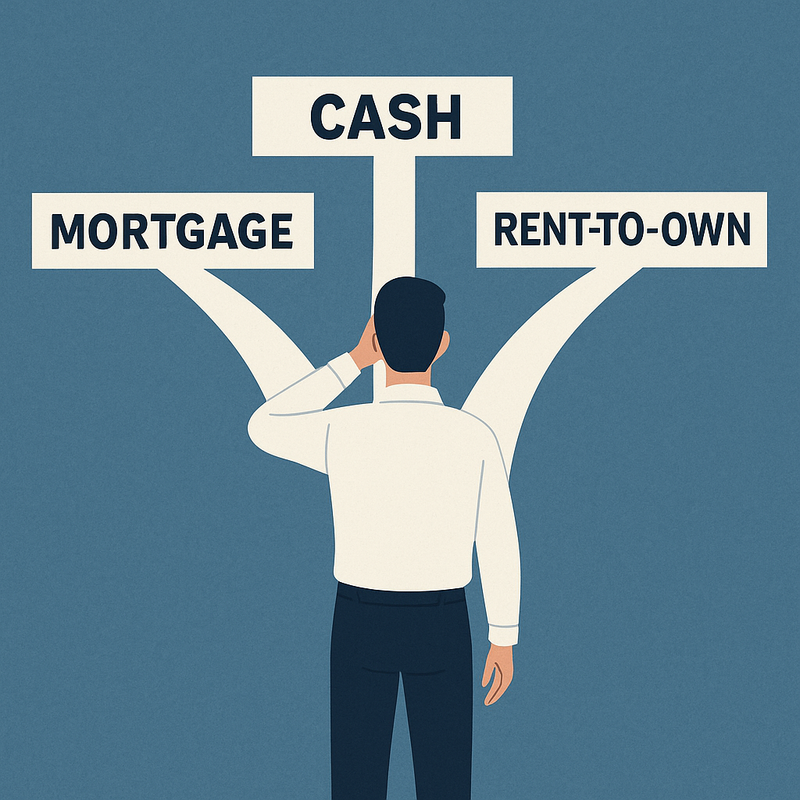
The decision ultimately depends on personal circumstances. Cash is best for those with available funds who value speed and security. Mortgages are suitable for those who can meet the eligibility requirements and want to spread out payments while maintaining liquidity. Rent-to-Own is the most flexible option for buyers who are financially capable but blocked by bank requirements or who prefer to move in immediately while paying gradually.
Buying property in Thailand is not a one-size-fits-all process. Cash purchases remain the simplest, mortgages provide structured financing but are out of reach for many foreigners, and Rent-to-Own offers an innovative bridge for buyers who fall between the cracks of traditional financing.
For foreigners especially, Rent-to-Own has become an attractive solution: it avoids the hurdles of bank approvals, allows immediate move-in, locks in today’s price, and builds equity along the way. For sellers, it provides a faster route to transactions and stable income.
As Thailand’s property market evolves, these three models will continue to shape how both locals and foreigners enter the market. Choosing the right one depends not just on financial ability but also on personal priorities, long-term goals, and willingness to navigate the complexities of ownership.
👉 To see properties already available under Rent-to-Own, visit FazWaz’s Rent-to-Own listings.
1. Can foreigners buy any type of property in Thailand?
Foreigners can own condominium units outright, provided that foreign ownership in the building does not exceed 49 percent of total unit area. Land ownership is more restricted: foreigners cannot own land directly but can lease it long-term (up to 30 years, with possible renewals) or set up certain company structures with careful legal advice. Houses built on leased land can also be owned, but the land itself remains leased.
2. What is the minimum down payment required for foreigners in Thailand?
For cash purchases, the full property price is required upfront. For mortgages, foreigners are usually asked to contribute 30–50 percent of the property’s value as a down payment, far higher than the 10–20 percent often available to Thai nationals. For Rent-to-Own, the initial deposit is typically 20–30 percent, with the remainder paid in installments.
3. How difficult is it for foreigners to get a mortgage in Thailand?
Mortgages are available but challenging. Banks often require long-term visas, work permits, high stable income, and extensive documentation. Loan-to-value ratios for foreigners are lower than for Thais, and rejection rates are high. Some banks, like UOB, do lend to foreigners under strict conditions, and institutions like MBK Guarantee provide smaller-scale loans without nationality restrictions.
4. What happens if I cannot complete payments under a Rent-to-Own agreement?
If a buyer defaults or decides not to exercise the purchase option under Rent-to-Own, the agreement usually ends, and prior payments (such as deposits or option fees) may be forfeited as compensation for the seller. With FazWaz’s structured program, the terms are transparent from the start, giving both buyers and sellers clarity on their rights and obligations.
5. Is Rent-to-Own legally safe in Thailand?
Yes, when structured properly. Rent-to-Own contracts are based on existing Thai lease and hire-purchase laws, with the property title only transferring once all payments are complete. FazWaz works with standardized legal templates, escrow services, and licensed partners to ensure security for both parties. Buyers should always ensure agreements are properly drafted and, if needed, reviewed by a lawyer.
6. Which option is best for foreigners: Cash, Mortgage, or Rent-to-Own?
It depends on personal circumstances. Cash is best for those with available liquidity and who want immediate ownership. Mortgages suit long-term expats with strong financial documentation who qualify under bank rules. Rent-to-Own is ideal for foreigners who cannot meet bank requirements but still want to move in and gradually secure ownership.
7. Can I rent out a property I buy through Rent-to-Own?
In most cases, Rent-to-Own agreements are designed for owner-occupiers, not investors. However, some contracts may allow subleasing or rental income if agreed upon with the seller. Buyers should clarify this in the agreement before signing.

 Language
  Price display

