- List your property - it's free
- Sign up or Log in
- English- en
- THB - ฿
- Buy
- Thailand Property For Sale
- Thailand Real Estate
- See Newest Listings
- Why Buy with FazWaz
- Rent
- Sell
- Financing
- Projects
- Advice
- Join Us We're Hiring!

Thailand’s property market in 2025 is experiencing a gradual rise in prices despite muted demand. On the back of high land and construction costs, housing prices have continued to inch upward even as buyer demand remains subdued. Nationwide, residential property prices were up about 2.7% year-on-year as of Q2 2025, according to the Bank of Thailand index. Single detached houses saw price growth around 2.6% annually, while townhouses climbed by a higher ~4.9%. This steady price increase comes even as both local and foreign buyers have been cautious, and developers slowed new projects amid economic uncertainties.
Regional differences are notable. The southern region (home to many tourist hubs like Phuket) led the nation with prices rising about 5.5% year-on-year, reflecting a strong post-pandemic rebound in demand there. In contrast, the northern region saw only about 1.8% annual growth, indicating a more sluggish market in places like Chiang Mai. Bangkok and its vicinity showed roughly 2.5% growth, just under the national average. Overall, industry experts predict Thai property values will keep trending upward modestly. Forecasts for 2025 generally range from about a 2–3% price rise on the conservative end to as much as 5–7% annual growth in more optimistic scenarios. In short, no price crash is expected, but neither is a boom – the market is on a gentle upswing as it stabilizes post-crisis.
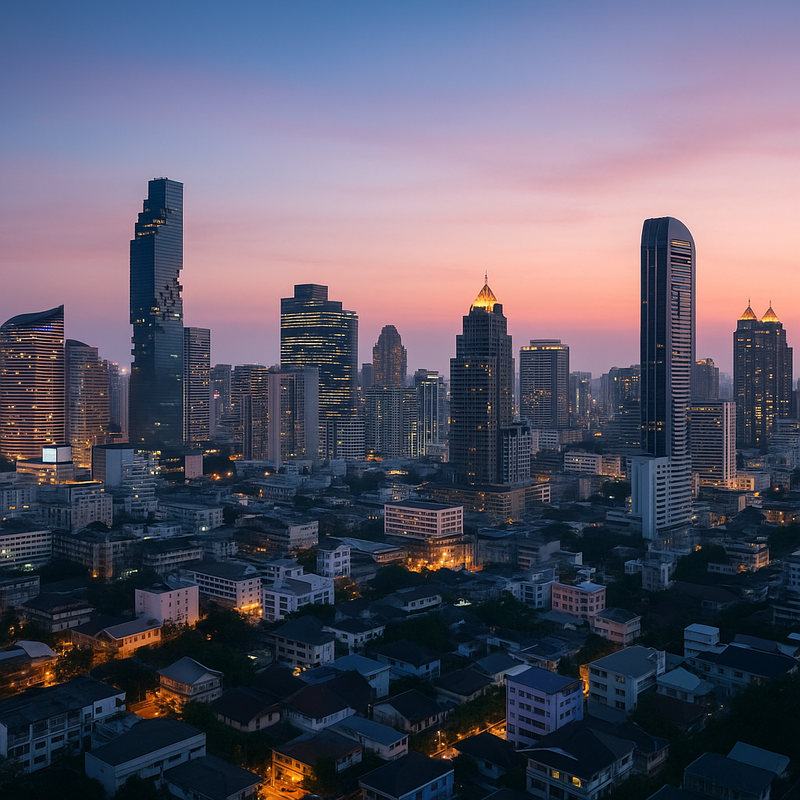
Buyer demand in 2025 is mixed, with domestic purchasers and foreign investors showing somewhat different trends. Thai buyers on the whole have been more hesitant this year. Many locals face high household debt and an uncertain economic outlook, which has led them to postpone home purchases and be very selective. Consumer purchasing power in Thailand has been soft, and banks have tightened lending to some extent due to credit quality concerns. This caution is evident in the slowdown of home sales compared to the previous year. Developers report that a number of would-be Thai buyers are waiting to see how economic conditions play out before committing to a property purchase. As a result, overall transaction volumes have dipped slightly and developers have held back on launching new projects, focusing instead on clearing their existing unsold inventory.
By contrast, foreign buyer interest has proven relatively resilient. International buyers continue to see Thailand as an attractive market, especially for holiday homes and investment condos. In fact, foreign demand only edged down by about 0.5% in Q1 2025 compared to a year earlier, a very marginal decline. Official data show 3,919 condominium units were transferred to foreign buyers in Q1 2025, worth around THB 16.4 billion (USD 485 million) in value. This means foreigners accounted for roughly 18% of all condo transfers nationwide in that period – a share that actually increased from about 16.7% the year prior. In other words, even though the absolute number of foreign-bought units dipped slightly, their market share grew, indicating domestic sales fell more than foreign sales. Notably, foreign buyers made up about 29% of total condo transaction value, up from ~28% a year before. This highlights that overseas purchasers remain a significant force, especially in the condominium segment.
Who are these foreign buyers? Chinese nationals continue to be the dominant group by far, comprising about 37.8% of foreign property purchases by number of units. Other sizable groups include buyers from Myanmar (~11%), Russia (~7%), and Taiwan (~5%), with a mix of Europeans, Americans, and others making up the rest. The majority of foreign buyers focus on condominiums, since Thai law makes condos the easiest property type for non-citizens to own outright. Interestingly, more than half of the units foreigners bought in early 2025 were priced under THB 3 million (around USD 90,000). These tend to be smaller apartments (studio or one-bedroom in the 30–60 square meter range), which are popular for rental investments or vacation homes. It shows that foreign investment isn’t limited to ultra-luxury properties; many overseas buyers are purchasing mid-market condos as well.
In terms of locations, Bangkok is the largest market for foreign purchasers, accounting for about 43% of foreign condo transfers. Thailand’s capital remains attractive for its urban lifestyle, jobs, and educational opportunities, as well as rental potential to expats and locals. The eastern coastal province of Chonburi, which includes Pattaya, is the second most popular area – about 33% of foreign-bought units were there. Chonburi offers seaside living within easy reach of Bangkok, and it has a well-established expat community. Other hotspots include Phuket, famed for its resort lifestyle, and Chiang Mai, the cultural northern city, as well as some Bangkok suburbs like Samut Prakan. Each of these areas has unique appeal: Phuket for beaches and holiday rentals, Chiang Mai for its affordable living and charm, and so on. Overall, foreign buyers tend to gravitate toward either the bustling Bangkok metro area or Thailand’s resort and retiree-friendly cities.
Given the softening local demand, the Thai government and developers have introduced measures to stimulate buying. The government in 2025 rolled out some financial incentives: for example, it cut the transfer taxes and mortgage registration fees for property purchases (effective April 2025 through mid-2026). These fee reductions lower the upfront cost for buyers (both Thai and foreign) when transferring property ownership. Additionally, the Bank of Thailand temporarily relaxed loan-to-value (LTV) rules, essentially allowing higher mortgage loans relative to property value through June 2026. This makes it easier for qualified buyers (mostly Thai citizens, since foreigners rarely get local mortgages) to finance a home with a smaller down payment. Policymakers hope such moves will boost housing affordability and encourage fence-sitters to enter the market. At the same time, many developers are offering promotions and discounts to clear existing stock, especially in the condo market where an oversupply of lower- to mid-priced units has built up. It’s something of a buyer’s market in 2025 for mid-range condominiums, so purchasers can find good deals and incentives – from price cuts to free furniture or extended payment plans – as sellers compete for business.
Shifting lifestyle preferences and regulations have influenced what types of properties are in demand. Among Thai nationals, there is a noticeable preference for landed homes (single-family houses or townhouses) in suburban areas, as opposed to high-rise city condos. During the pandemic years, many families came to value larger living spaces and perhaps a small yard, and that trend continues. Major developers report that a majority of their new sales are low-rise houses, driven by young families seeking more space at affordable prices in the suburbs. For instance, one of Thailand’s largest developers, Sansiri, noted that over 60% of its sales now come from low-rise housing rather than condos, reflecting strong demand from family buyers for spacious homes in commuter towns. Areas like Nonthaburi and Pathum Thani (just outside Bangkok) have become popular for such buyers, as they offer larger homes at lower cost than the city center while still being within reach of Bangkok’s jobs.
In contrast, urban professionals and many foreigners continue to favor condominiums in Bangkok and other cities for their convenience and amenities. Modern condos in central Bangkok (areas like Sukhumvit, Sathorn, and Silom) remain in high demand due to proximity to workplaces, public transit, and entertainment. These high-rise developments often come with facilities like pools, gyms, and security, which appeal especially to busy professionals and expats. However, the condo market’s performance has been more mixed in 2025. In Bangkok, condo prices have seen only modest growth (around +1.4% year-on-year), lagging behind the gains in the low-rise segment. Meanwhile, prices for townhouses (a popular form of low-rise attached housing) jumped nearly 5% year-on-year in Bangkok. The stronger price appreciation for landed homes underscores that local end-user demand is concentrated in bigger, ground-level properties. Condos, on the other hand, have a higher share of investor and foreign demand, which has been recovering gradually but not explosively. This divergence – “houses for space, condos for location” – is a key trend. It suggests that if you’re buying in 2025, you should consider how the property type aligns with your needs: a condo for convenience and possibly rental yield, versus a house for long-term living and family space.
Another trend is the emphasis on location and infrastructure. Buyers, both Thai and international, are increasingly aware of the impact of new infrastructure projects on property values. One major project on the horizon is the planned high-speed rail network that will connect Bangkok with cities like Pattaya (Chonburi), Hua Hin, and eventually Chiang Mai. This has led to heightened interest in properties near future rail stations, particularly in Pattaya which is expected to become even more accessible from the capital. Investors anticipate that improved connectivity will drive up real estate values in these linked cities over the coming years. Likewise, expansions of major airports in Bangkok, Phuket, and Krabi are underway, aiming to handle more tourists and travelers. Properties located conveniently to these expanding airports (or along transit lines to them) are seen as having good upside potential as travel increases.
Thailand’s push to develop the Eastern Economic Corridor (EEC) – a high-tech industrial and logistics zone covering parts of Chonburi, Rayong, and Chachoengsao provinces – is also influencing the property market. The EEC is attracting businesses and expat workers, which in turn fuels demand for both residential and commercial properties in that eastern region. For example, more professionals working in the EEC might choose to live in Pattaya or Bang Saray and commute, driving housing demand there. Overall, areas with new infrastructure or economic projects are hotspots in 2025, and many buyers are factoring future developments into their location choices.
Meanwhile, the return of tourism after the pandemic has boosted demand for properties that can serve as short-term rentals or holiday homes. Tourist-heavy locales like Phuket, Pattaya, and Chiang Mai are seeing a surge in interest from investors who want to rent to vacationers. The tourism sector rebounded strongly through 2023 and early 2024, and although growth in visitor numbers has leveled off a bit in 2025, Thailand is still expecting a substantial influx of tourists this year (on the order of tens of millions of visitors). In popular destinations, this translates to high occupancy for Airbnb-style rentals and hotel-like returns for property owners. It’s estimated that rental yields in prime tourist areas such as Phuket and Pattaya can reach around 8–10% annually under favorable conditions. By comparison, typical long-term rental yields in Bangkok condos are about 5–6% on average. The allure of these higher yields has drawn both local and foreign investors to look for condominiums or villas that cater to tourists. For instance, a sea-view condo in Pattaya or a villa in Phuket could generate strong short-term rental income during peak holiday seasons, sometimes significantly outperforming standard city rentals. This is enticing for those who don’t mind managing rentals or hiring a property manager. However, potential investors should always consider the seasonality and management costs involved – while peak season returns can be high, off-season occupancy might be much lower.
For foreigners looking to buy property in Thailand, 2025 brings a mix of promising opportunities and important rules to understand. Thailand has long been popular among expats, retirees, and international investors due to its low cost of living and attractive property values (compared to many Western markets). The good news is that Thai authorities are actively making it more welcoming for foreign investment in real estate. In late 2024, the government approved significant changes to ease foreign ownership restrictions. One major reform will raise the foreign ownership quota in condominium buildings from 49% to 75%. This means foreigners will be allowed to own up to 75% of the units in a given condo development (previously, at least 51% of units had to be Thai-owned). In practice, this change helps foreign buyers in popular buildings where the old 49% cap was often quickly reached. A higher quota means more available units for foreign purchasers, reducing a common hurdle non-Thais faced when buying condos.
Another proposed change extends the maximum lease term for land. Traditionally, Thai law prohibits foreigners from owning land outright, but they can lease land (or houses) long-term. The standard lease length is 30 years (with options to renew). Under new rules approved in principle, foreigners will be able to secure leases up to 50 years, with an automatic right to renew for another 49 years – effectively up to 99 years of leasehold control. This long lease term is almost as good as ownership for most practical purposes, since 99 years can cover a lifetime and beyond. The government hopes these moves will stimulate property sales by giving foreign buyers more confidence and stake in the market. There is an oversupply of condos in some segments, and attracting more overseas investment should help absorb inventory (which ultimately benefits Thai developers and the broader economy as well).
It’s important to note that as of 2025, these reforms are either newly in effect or in the process of implementation. Currently, a foreign buyer can fully own a condominium freehold in their own name, as long as the foreign ownership quota in that building hasn’t exceeded 49%. With the quota expansion, this threshold will rise to 75% once enacted. Foreigners cannot own land or landed houses outright in their name (land ownership is restricted to Thai citizens and majority-Thai companies by law)restproperty.com. However, there are legal workarounds such as leaseholds, as mentioned, or setting up a Thai company to hold the land (though the latter must not be done as a mere nominee arrangement, which is illegal). The most straightforward method for foreigners is to buy a condominium or take a long-term lease on a villa/house. For example, many expats lease houses for 30 years (often with a pre-agreed renewal to total 60 or 90 years). This grants essentially all usage rights – you can even build or renovate a house on leased land, and the structure can be owned by you separately from the land. The lease is registered at the Land Department, giving a measure of security. Still, because the renewal beyond 30 years is not guaranteed (it depends on contract and future enforcement), some foreign buyers stick to condos for true freehold ownership.
Beyond property laws, Thailand has also rolled out visa and residency programs to attract foreign buyers. One notable program is the Thailand Elite Visa, a long-term visa package that, for a fee, grants residency privileges for 5 to 20 years along with VIP perks. This program has drawn many retirees, investors, and digital nomads who want to base in Thailand without hassle. While the Elite Visa itself doesn’t grant permission to work (it’s basically an extended tourist visa), it complements property ownership by making it easy for foreigners to live in Thailand for extended periods to enjoy or manage their property. Additionally, Thailand introduced in 2022 the Long-Term Resident (LTR) visa targeting “wealthy global citizens,” retirees, professionals, and specialists – which, among other benefits, can allow qualifying individuals to own property more freely and even some land (in limited cases) as part of investment incentives. The overall trend is that Thailand is opening its doors wider to foreign investment in real estate, seeing it as a way to boost the economy.
For foreigners buying in Thailand, a few practical considerations are key. First, always use a reputable local lawyer to review contracts and ensure a smooth process. Thailand’s property system may be unfamiliar, and laws can change, so legal guidance is important – for instance, to conduct a title search, draft the sale agreement, and navigate transfer at the Land Office. Second, be aware of foreign exchange rules: the funds used to buy a condo must generally be remitted in foreign currency and exchanged into Thai Baht upon arrival (for condos, you’ll need a Tor Tor 3 form from the bank as proof of foreign funds in order to register the unit in your name). Also, if you plan to rent out your property, understand the local regulations (certain areas have zoning rules on short-term rentals) and tax obligations. Finally, despite Thailand’s warm welcome, foreign buyers should maintain realistic expectations. Some seasoned investors caution that property values in Thailand, while steadily rising, are not skyrocketing, and returns hinge on long-term growth and rental income rather than quick flips. Thailand’s economy has been growing at a modest pace (2–3% GDP growth in recent years), and factors like an aging population and high household debt could moderate future property gains. Therefore, it’s wise to buy with a medium- to long-term horizon and focus on the lifestyle or yield benefits, rather than expecting rapid appreciation.
Looking ahead, the Thai real estate market in 2025 offers a stable environment with plenty of opportunities for different types of buyers. Whether you are a Thai national looking for your first home, or an expatriate investor seeking rental income, here are some practical tips and insights to navigate the market:
Finally, approach any property purchase with a long-term perspective. The Thai real estate market in 2025 is best characterized as stable and maturing, rather than skyrocketing. You are unlikely to “get rich quick” flipping properties in the short term, as price growth is moderate and tied to economic fundamentals. However, as a medium to long-term investment, Thai property can be very rewarding – you get the benefit of usage (or rental income) now, and gradual appreciation over time. Many buyers, especially foreigners, also value the lifestyle return: living in a warm, friendly country with abundant amenities and low living costs is a huge part of the appeal. In summary, Thailand’s real estate market in 2025 offers a mix of traditional charm and modern opportunity. With prudent planning, whether you’re buying a dream retirement condo by the beach or a starter home in the city, you can find good value and make a sound investment in the Land of Smiles.

 Language
  Price display

